Working in French healthcare
Job offers, one at a time. No account needed.
Nurse, care assistant, doctor: French hospitals and care homes hire internationally. Full support on degree equivalence.
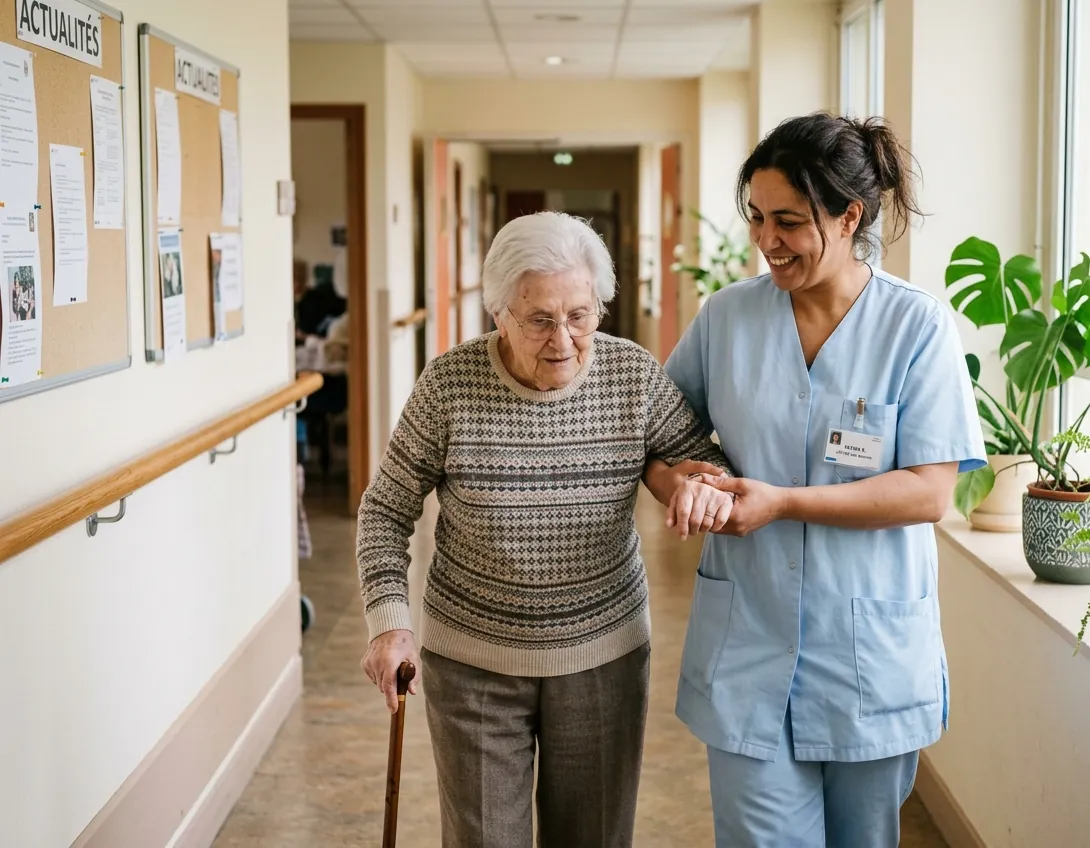
Public hospitals, private clinics, EHPADs, retirement homes, medico-social centres: French healthcare faces a chronic shortage of medical staff. Over 60,000 nurse positions, 30,000 care assistant positions and several thousand doctor positions remain vacant every year. Graduates from outside the European Union can practise in France after equivalence or via the practice authorization procedure (PAE), supported by ObjectiFrance from start to finish. Care assistant, state-registered nurse, specialist doctor, midwife: each profile is matched with verified healthcare facilities under salaried, contractual or Passeport Talent — Medical profession status (CESEDA Art. L313-20). Guaranteed conditions: collectively bargained salaries, sometimes facilitated housing, support during settlement.



Six healthcare roles open to international candidates.
France's official statistics body (DREES) estimates more than 90,000 healthcare jobs vacant every year. Below are the most sought-after profiles in 2026.
№ 01
Care assistant
€1,850 – €2,300Permanent / long fixed-termComfort and hygiene care, support with daily tasks. Care-assistant State Diploma (DEAS) or recognized equivalence required.
Voir les offres№ 02
State-registered nurse
€2,200 – €2,900PermanentTechnical care, patient monitoring, coordination with doctors. Practice authorization procedure (PAE) required for non-EU degrees.
Voir les offres№ 03
General practitioner
€4,500 – €7,000Hospital-employedFirst-line medicine in hospitals or health centres. PAE mandatory for non-EU degrees — three knowledge-verification exams.
Voir les offres№ 04
Specialist doctor
€5,500 – €9,000Permanent / hospital practitionerAnaesthesia, geriatrics, psychiatry, radiology: highly strained specialties. Passeport Talent — Medical profession possible (Art. L313-20).
Voir les offres№ 05
Midwife
€2,800 – €3,600PermanentPregnancy follow-up, delivery, post-partum. High-demand profession across France, especially in rural areas and overseas territories.
Voir les offres№ 06
Home-care auxiliary
€1,867 – €2,100Permanent / fixed-termHome support for elderly or disabled people. DEAVS diploma or experience-validation route (VAE).
Voir les offres
Three reasons to practise in France.
— I
Historic care-staff shortage
Over 60,000 nurse positions and 30,000 care-assistant positions vacant every year. All these roles are on the shortage-occupation lists of many regions (order of 21 May 2025) — your work permit is processed as a priority.
— II
PAE supported A to Z
The Practice Authorization Procedure (PAE) lets non-EU doctors, nurses and midwives practise in France. ObjectiFrance supports the CNG file, the knowledge-verification exams and Order registration.
— III
Secure public-sector career
Public hospitals offer tenure, guaranteed pension, continuous training, internal mobility. Non-profit private nursing homes (associations, mutuals) guarantee the same rights as public service.
Your steps, with the law to back them up.
Practising healthcare in France requires equivalence or practice authorization. Below are the texts your ObjectiFrance advisor applies.
- — Public Health Code Art. L4111-2
Practice authorization (PAE)
Procedure allowing non-EU practitioners to practise in France. Knowledge verification by national exams (EVC), consolidation programme of 1 to 3 years depending on specialty.
- — CESEDA Art. L313-20
Passeport Talent — Medical profession
4-year residence permit for a practitioner recruited by a French public health establishment. Reserved for non-EU doctors, midwives, dentists and pharmacists.
- — Labour Code Art. R5221-21
High-demand occupations
Care assistant, nurse, home-care auxiliary, midwife and several medical specialties are on the shortage-occupation lists of many regions (order of 21 May 2025). Fast-track DREETS procedure.
- — Agreements CCN 51 / FPH
Healthcare collective agreements
FPH (public hospital civil service) for public sector, CCN 51 (FEHAP) for non-profit private, CCN 66 for medico-social. Wages, bonuses, leave, mutual all collectively negotiated.
How much do you earn in French healthcare?
Indicative gross monthly figures in euros, excluding bonuses (night, Sunday, service, Ségur). 2026 SMIC (since 1 June): €1,867.02 gross. The Ségur reform raised all care-staff pay by €183 net/month.
| Role | Minimum | Maximum |
|---|---|---|
| Care assistant | €1,850 | €2,300 |
| Home-care auxiliary | €1,867 | €2,100 |
| Registered nurse | €2,200 | €2,900 |
| Midwife | €2,800 | €3,600 |
| General practitioner | €4,500 | €7,000 |
| Specialist doctor | €5,500 | €9,000 |
— Source: 2026 FPH index scales, CCN 51 / FEHAP agreement, DREES. Night, Sunday, holiday and Ségur bonuses added on top.
Where the demand is highest.
The care-staff shortage hits all of France, with varying intensity. Rural areas and overseas territories are the hardest hit.
Île-de-France
— AP-HP, university hospitals
AP-HP is Europe's largest hospital group. Over 5,000 nurse positions vacant every year. Roles in CHU, nursing homes, home care.
French Overseas
— Mayotte, French Guiana, Réunion
Extreme tension: doctors and nurses sought. Mobility allowances, remoteness bonuses (up to 40% on salary), housing often provided.
Rural regions
— Centre, Burgundy, Limousin
Medical deserts. Municipalities often offer settlement aid: housing, company car, several-thousand-euros engagement bonus.
Hauts-de-France
— Lille teaching hospital, nursing homes
Dense population, many hospital structures. Strong tension on all care roles, particularly in nursing homes and rehab care.
PACA & French Riviera
— Ageing population
Strong concentration of private clinics and upper-tier nursing homes. Marseille, Nice, Toulon: opportunities in geriatrics and palliative care.
Grand Est & Burgundy
— Strasbourg, Reims, Dijon
Quality university hospitals, strong demand in specialties (anaesthesia, ER, geriatrics). Borders Switzerland and Germany — mobility options.
Three steps to your healthcare role.
- 01
Build your candidate file
Diploma, years of study, specialty, hospital experience. Upload translated diplomas, employer letters, study transcripts.
- 02
PAE procedure with full support
For non-EU doctors, nurses and midwives: building the CNG file, registering for knowledge-verification exams, follow-up of the practice-authorization committee.
- 03
Prepare your arrival
Order registration (doctors, midwives), social-security affiliation, bank account, housing search. For doctors in tight zones, settlement bonuses possible.
Applying from the Maghreb?
Consular procedures, work authorisation and qualification recognition vary by country of origin. Check the dedicated guide for your nationality and the official channels (OFII, ANAPEC/ANEM/ANETI, France-Visas).
— By country of origin
— Process & support
Everything you need to know before leaving.
Is my foreign care-assistant diploma recognized in France?
For non-EU care assistants, an equivalence is generally granted after DRJSCS verification of the training programme. The procedure takes 4 to 12 weeks. Otherwise a top-up training of a few months may be required — often paid for by the employer.
What is the practice authorization procedure (PAE)?
PAE allows non-EU doctors, nurses, midwives, dentists and pharmacists to practise in France. It includes national knowledge-verification exams (EVC), a consolidation programme in hospital (1 to 3 years depending on specialty), then an opinion from the authorization committee.
How much does a nurse earn in France?
A state-registered nurse starts around €2,200 gross/month in a public hospital, before bonuses. With Ségur (€183 net), night, Sunday and seniority bonuses, monthly net pay can reach €2,800 to €3,200 after a few years.
What is the Passeport Talent — Medical profession?
A 4-year renewable residence permit (CESEDA Art. L313-20) for non-EU practitioners recruited by a French public health establishment. Spouse and children join immediately, with automatic spouse work authorization.
Are there bonuses for settling in rural areas?
Yes. GPs settling in under-served zones (ARS map) can receive a €30,000 to €50,000 commitment bonus, low-rent housing, sometimes a vehicle. Municipalities often add their own incentives.
Which regions have the strongest shortage?
French Overseas (Mayotte, French Guiana, Réunion): extreme tension with significant remoteness bonuses. Rural regions: Centre-Val de Loire, Burgundy, Limousin, Auvergne. All regions seek care staff — the shortage is national.
Do I need to speak French to practise healthcare?
Yes, B2 minimum required for doctors (TCF or DELF B2 demanded by the Order). B1 for nurses and care assistants. For home-care auxiliaries: A2 often suffices. Classes are sometimes employer-funded.
How long does the PAE take?
For a non-EU nurse: 12 to 18 months (file building, EVC, consolidation programme). For a doctor: 18 to 36 months depending on specialty. ObjectiFrance walks you through every step — significant time savings vs going it alone.
Are there any fees to pay to ObjectiFrance?
Applying is free and unlimited for every candidate. If you want an advisor to prepare your file and send your applications with you, France ★ costs €89 (6 months), or France ★★ at €490 with your arrival in France (12 months), with a 30-day money-back guarantee. Nobody should sell you a contract or a job in a healthcare facility: anyone asking you for an upfront payment in our name is a scammer — report them to us.
Can my hospital permanent contract lead to French citizenship?
Yes. Five years of regular French residency grant the right to apply for naturalization through work (Civil Code Art. 21-15), provided you master French (B1) and prove integration. Foreign care professionals are routinely naturalized given their essential public-service contribution.
Land a role in French healthcare.
An email to start. A guided file. A team by your side. Never alone in front of paperwork again.
— 100% free to apply
You are abroad: our team in France finds employers, calls them and submits your applications for you within 72 h.Discover France ★